

Policies
Article 1-1 states that NTU will continue to "Identify and monitor species through conducting Campus Biodiversity Survey regularly. Set up campus biodiversity database and implement improvement measure when species diversity or abundance decline. Method and result from the Campus Biodiversity Survey should be published online, and be the basis for formulation the Campus Biodiversity Strategy & Action Plan."
Article 1-2 "Prioritize the conservation and restoration of native plant species and ensure healthy habitats for native species."
Article 5-2 "Support partnership with neighboring communities to jointly preserve ecosystem surrounding the campus and enhance residences’ awareness on biodiversity. Provide NTU campus for neighboring school as their Environmental Education Facility and Field, thereby fulfilling the mission of University Social Responsibility."
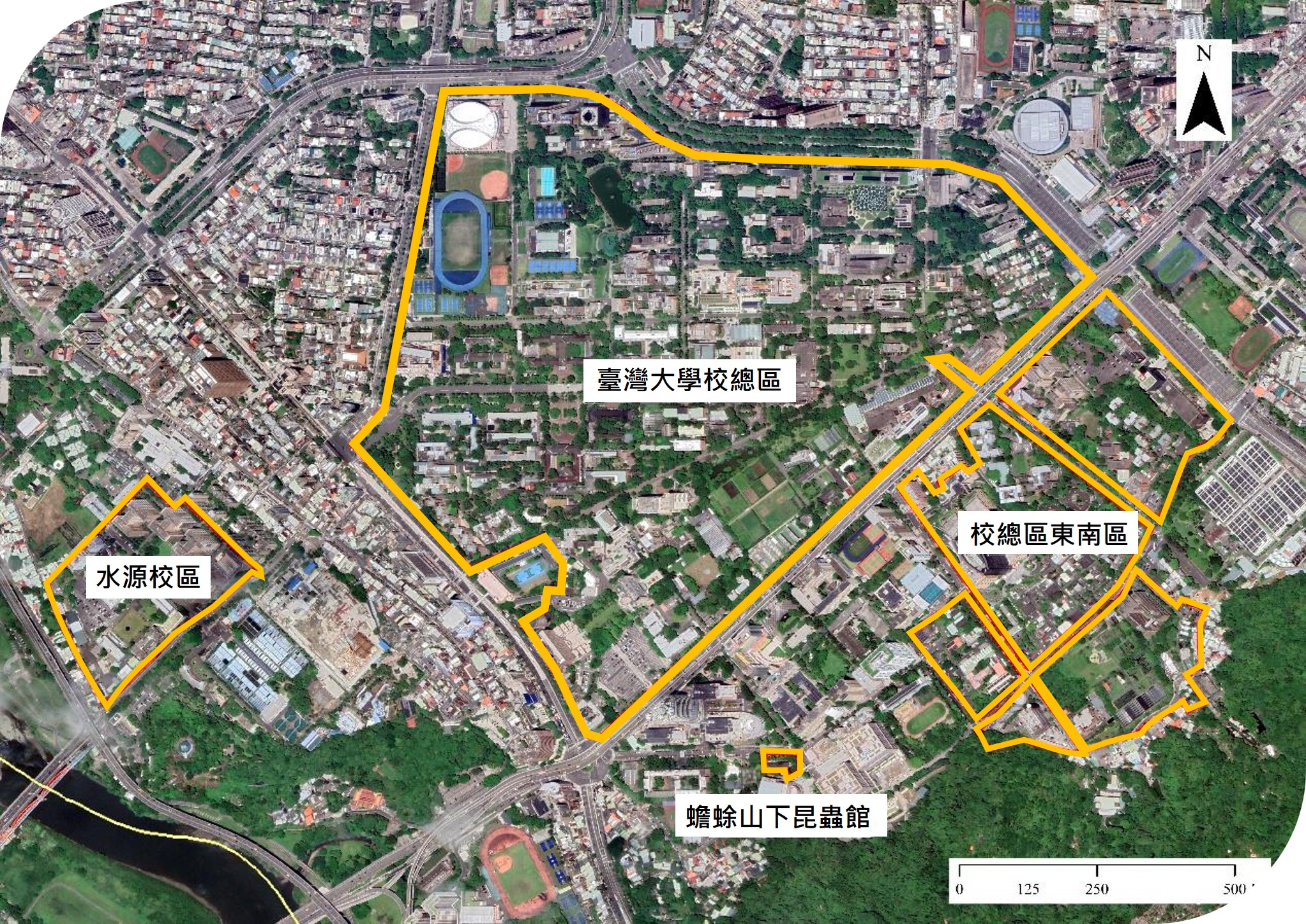
According to NTU Biodiversity Survey in 2023, two globally threatened IUCN Red List species on NTU-associated land: the Critically Endangered Yellow Pond Turtle (Mauremys mutica) and the Vulnerable Taipei Flying Frog (Zhangixalus taipeianus)." With 20 years of survey records, NTU has identified, monitored, and conserved these species living in our campus. The Following list is all the species on the IUCN Red List and being included in Taiwan's Schedule of Protected Wildlife. (National Conservation List)
- 柴棺龜 — Mauremys mutica:CR – Critically Endangered(極危. (At NTU farm)
- 臺北樹蛙 — Zhangixalus taipeianus:VU – Vulnerable(易危. (13 records)
- 食蟹獴 — Urva urva:LC – Least Concern(無危)。
- 大冠鷲 — Spilornis cheela:LC – Least Concern(無危)。
- 鳳頭蒼鷹 — Accipiter trivirgatus:LC – Least Concern(無危)。
- 紅尾伯勞 — Lanius cristatus:LC – Least Concern(無危)。
- 八哥 — Acridotheres cristatellus:LC – Least Concern(無危)。
- 臺灣藍鵲 — Urocissa caerulea:LC – Least Concern(無危)。
- 黃鸝 — Oriolus chinensis: LC – Least Concern(無危)。
- 松雀鷹 — Accipiter virgatus: LC – Least Concern(無危)。
- 領角鴞 — Otus lettia: LC – Least Concern(無危)。

(Additional policy for the Experimental Forest)
-
Regulations Governing the Management of Valuable, Reserved, and Rare Trees of the Experimental Forest Management Office, National Taiwan University (Reviewed in 2022).
The “Regulations Governing the Management of Valuable, Reserved, and Rare Trees of the Experimental Forest Management Office, National Taiwan University” establishes a policy framework for identifying, monitoring, and protecting rare and threatened tree species within the NTU Experimental Forest and other university-associated land beyond campus.The policy defines rare trees based on conservation-related criteria, including native endemic species experiencing significant population decline, species at risk of extinction, species with small populations or restricted geographical distributions, species dependent on specific habitats, species that are difficult to propagate or restore, and species threatened by habitat destruction, disturbance, or overexploitation.
For identified species, the policy requires systematic documentation and monitoring, including species names and scientific names, reasons for conservation, GPS and GIS locations, elevation, tree size and age, health conditions, habitat characteristics, and photographic records. These records contribute to a comprehensive database supporting conservation and research.
Monitoring is conducted through comprehensive surveys every five years, routine patrols, and emergency surveys in response to natural disasters, illegal logging, land disturbance, or other incidents. Protection routes are also established and inspected at least annually. Registered valuable, reserved, and rare trees cannot be removed from official records without formal assessment and approval, ensuring their continued monitoring and protection.
Campus Biodiversity Survey
To learn about and manage the ecological environment and resources on campus, NTU has carried out regular Campus Biodiversity Survey since 2009, including the survey of birds, mammals, reptiles, insects, plants, and green coverage. The latest survey was conducted in 2023. The goal is to understand the distribution of various species on campus, as well as the rise and fall of native species and exotic species, the information of which will become a reference for NTU’s management of biodiversity. To increase participation in the ecological survey, domestic and international online resources are incorporated so that people can report sightings more easily, such as the black-crowned heron report system, the roadkill report system, ebird, and iNaturelist. Campus tours and training courses for volunteer tour guides are organized on a regular basis to help the faculty, students, and the public learn more about NTU’s ecological environment.